
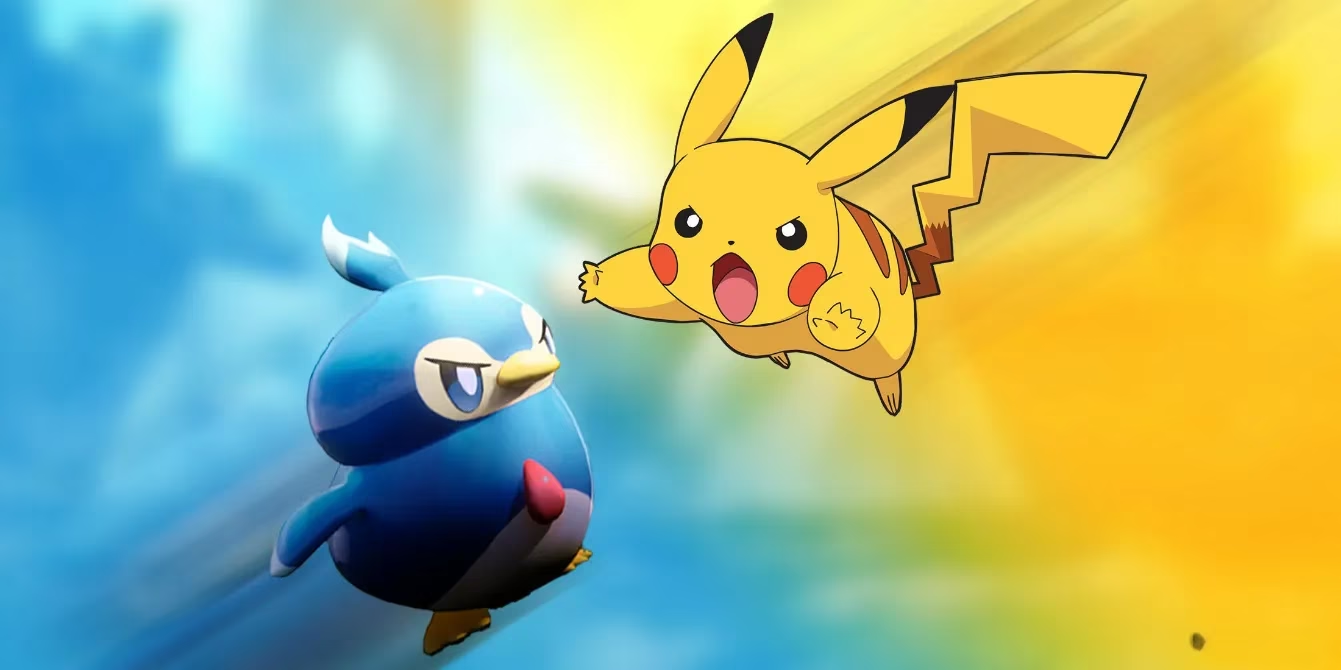
In the ever-twisting saga of gaming's great monster mash-up, 2026 finds Pocketpair, the developer behind the smash hit Palworld, officially trading legal documents with the industry titan Nintendo. The lawsuit, filed back in September 2024, has finally moved beyond corporate posturing into the procedural arena. Pocketpair has issued a formal, if preliminary, response, confirming the legal proceedings are underway while maintaining a stance of bewildered innocence. The studio labeled the situation as "unfortunate," a diplomatic term if there ever was one, and lamented that defending itself would now consume "significant time" better spent on expanding their monster-taming universe. Isn't it just the way? You're busy building your creature-collecting empire, and suddenly you have to drop everything to answer a summons from the house that Mario built.
The Core of the Controversy: Patents, Not Pals?
The twist in this tale is the legal angle itself. When Nintendo first announced the lawsuit, the collective assumption from armchair lawyers and industry pundits alike was that this would be a classic copyright brawl. After all, hadn't everyone from fans to former Pokémon Company attorneys like Don McGowan—who famously called Palworld "ripoff nonsense"—pointed out the, let's say, familiar silhouettes of some creatures? Yet, Nintendo's complaint, filed in the Tokyo District Court alongside co-plaintiff The Pokémon Company, alleges infringement of multiple patents, not copyrights. Pocketpair's response highlights this confusion, stating the company is "unaware of any intellectual property that Palworld could be infringing on" and has not yet learned the specifics of the alleged patent violations. One can almost picture the developers scratching their heads, looking at their guns-and-factories simulator, and wondering which patented gizmo they accidentally incorporated.
So, what could these mysterious patents be? Public IP records as of the lawsuit's filing showed The Pokémon Company and its subsidiaries held a treasure trove of at least 96 patents. Many of these aren't about cuddly character designs but describe underlying game mechanics. For instance, one might cover the specific process of "interacting with a character by throwing an object at it." Sound familiar? That's essentially the core loop of throwing a Poké Ball. Could Palworld's capture mechanics, despite the more... industrial approach, be treading on this legally protected ground? It's a question that moves the fight from "Do these Pals look like Pokémon?" to "Did you patent the act of throwing a sphere at a digital beast?"
The Long Road Ahead in Tokyo's Courts
If Pocketpair thought this would be a quick skirmish, they are in for a rude awakening. Patent litigation in Japan is not known for its speed. The typical timeline for a first-instance verdict stretches between one and two years, and that's for relatively straightforward cases. Given the high-profile nature of this clash, involving a global phenomenon like Palworld and a protective behemoth like Nintendo, the proceedings could easily drag on for much longer. The complexity of dissecting video game code and mechanics, coupled with crowded court dockets, means this legal battle could become a marathon, not a sprint. What does this mean for Palworld players? While Pocketpair promises continued development, one has to wonder how much creative energy and resources will be siphoned into the legal defense fund. Will updates slow to a crawl? Only time will tell.
A Community Divided and Watching
The court of public opinion has been in session since day one. This legal development has only fueled the fire. On one side, you have defenders of Palworld who see it as a bold, satirical evolution of the genre—a game that asks, "What if we gave these cute creatures guns and put them to work?" 🤔 On the other, purists and Nintendo loyalists view the lawsuit as long-overdue justice for what they perceive as blatant borrowing. The shift from expected copyright claims to patent allegations has added a new layer of intrigue. Is Nintendo pursuing this path because it's legally stronger, or is it a strategic move to attack the game's functional bones rather than its aesthetic skin?
| Expected Battle | Actual Battle | Implication |
|---|---|---|
| Copyright Infringement (Character Designs) | Patent Infringement (Game Mechanics) | Harder for public to judge; more technical legal fight. |
| Quick settlement or injunction | Multi-year court process | Long-term uncertainty for Palworld's development. |
| Focus on "look and feel" | Focus on "how it works" | Could set a precedent for gameplay patents industry-wide. |
In the end, the 2026 chapter of the Palworld vs. Nintendo saga is less about a dramatic courtroom reveal and more about the starting gun for a protracted war of attrition. Pocketpair is in the ring, gloves on, but still trying to figure out what the other fighter's strategy even is. As the legal wheels grind slowly in Tokyo, the gaming world watches, waits, and continues to debate: Is this the defense of innovation, or the protection of a legacy? One thing's for sure—the outcome will resonate far beyond just one game.
Comments