
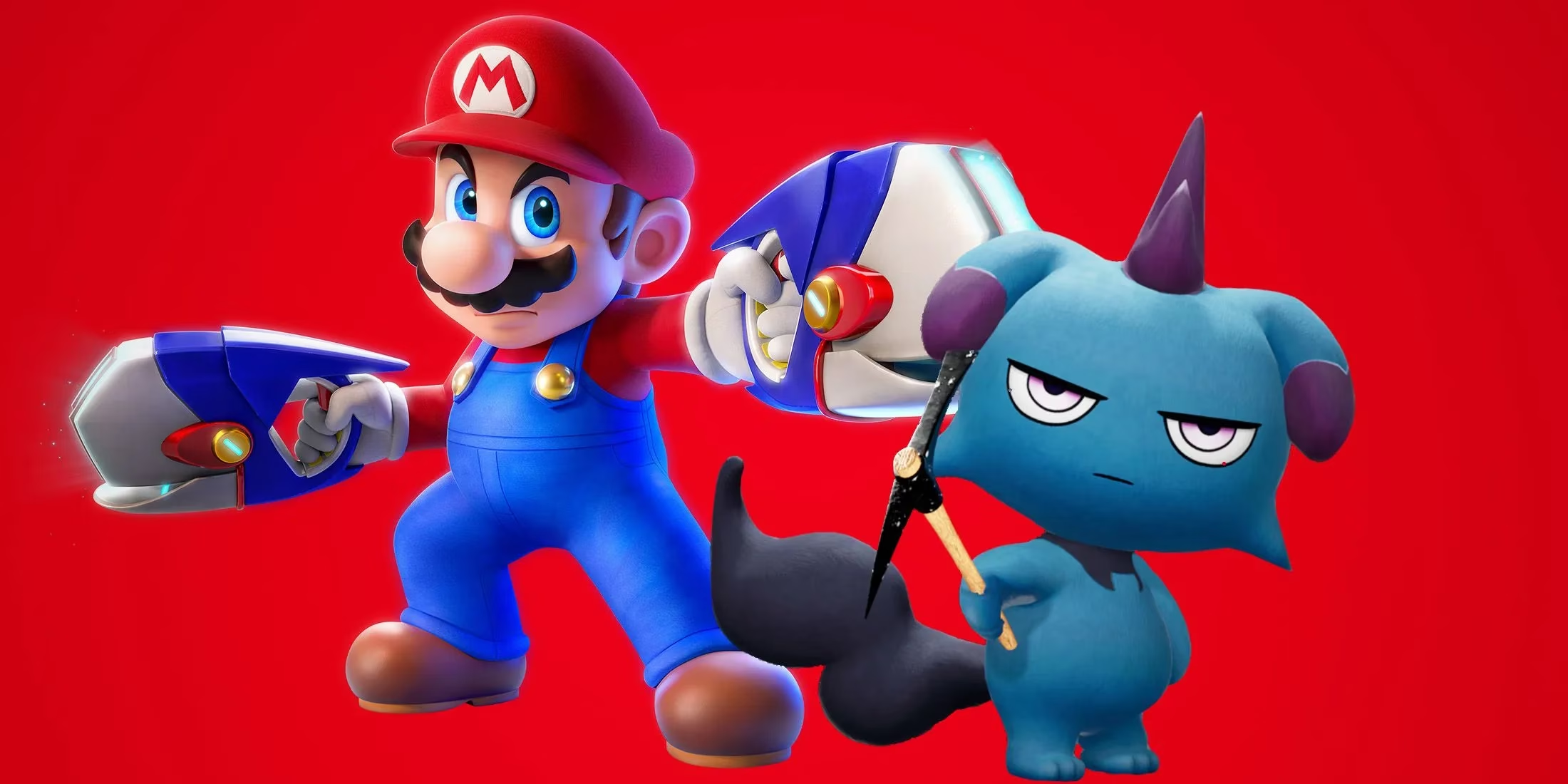
In September 2024, the gaming world was shaken by the news that Nintendo and The Pokémon Company had jointly filed a lawsuit against Pocketpair, the developer behind the global phenomenon Palworld. The complaint, submitted in the Tokyo District Court, alleges that the hit survival crafting game infringes on a number of Nintendo's patents. While the precise details remain under wraps, this legal move has sparked intense speculation about the future of Palworld and the potential for a landmark case in video game intellectual property law. However, according to a leading patent expert, this legal battle, while arduous, is unlikely to spell international doom for Pocketpair.
Reflecting on this turn of events, veteran patent analyst Florian Mueller offered a measured perspective. He told sources that he does not expect the case to have significant international consequences. "At most, [Nintendo] will do some damage in Japan, but probably not outside," he opined. This assessment suggests that the core gameplay of Palworld may continue to thrive in most global markets, regardless of the lawsuit's outcome in Japan. An early sign of this geographically contained impact may have already appeared. Shortly after the lawsuit was filed, Palworld was shadow-dropped for the PS5 in 68 countries—noticeably excluding Japan. Pocketpair itself acknowledged the lack of a Japanese PlayStation release date, though it stopped short of directly blaming the legal action. Could this be the first tangible effect of Nintendo's legal pressure?
The heart of the dispute likely centers on specific game mechanics. Japanese IP attorney Kiyoshi Kurihara has previously pointed to a Nintendo patent related to creature capture mechanics as a probable focal point. Mueller finds this to be a "plausible theory," but he adds a crucial legal nuance: the case "won't turn on infringement as much as on validity." This means the primary question for the court won't just be whether Palworld copied a mechanic, but whether Nintendo's patent on that mechanic is legally robust and enforceable in the first place. "Only because the Japanese Patent Office granted those patents doesn't mean that they couldn't be revoked or narrowed," Mueller explained. This shifts the battlefield from simple comparison to a complex examination of patent law itself.
Understanding the potential outcomes will become much clearer once the lawsuit's specifics are made public. Mueller advises caution until then: "Let's see when all the specifics are on the table, but it's not like Palworld infringes left, right and center on numerous IPs; they probably infringe on nothing that can withstand a serious court review." Interestingly, even Pocketpair was not given advance notice of the complaint's details, a fact the company highlighted in its initial response. Mueller noted that Nintendo's decision to file publicly without that courtesy is typical for a company on a "warpath," aiming to project a hostile and assertive stance from the outset.
For players and developers alike, the timeline is a critical factor. Patent disputes in Japan are not swift affairs; they commonly take between 12 and 18 months just to reach a first-instance verdict, assuming no settlement is reached beforehand. Mueller believes Nintendo's strategy may be less about securing a massive financial payout and more about seeing the legal process through to a definitive conclusion, potentially to set a precedent. In a recent prediction, he suggested this case is "more likely to last five years than to be settled during the first." This paints a picture of a protracted war of attrition rather than a quick skirmish.
What does this mean for the future of game development? 🤔
This lawsuit raises profound questions about the boundaries of inspiration and infringement in game design. If a patent for a broad mechanic like "creature capture" can be aggressively enforced, does it risk stifling innovation across the entire genre? On the other hand, companies like Nintendo have a right to protect their iconic, billion-dollar creations. The Palworld case could become a crucial test case in defining these boundaries, especially in Japan's legal landscape.
Key Points of the Legal Dispute:
-
Parties Involved: Nintendo & The Pokémon Company (Plaintiffs) vs. Pocketpair (Defendant).
-
Court: Tokyo District Court.
-
Core Allegation: Patent infringement related to game mechanics.
-
Expert Insight: International impact limited; case hinges on patent validity, not just infringement.
-
Potential Timeline: 1.5+ years for initial verdict; could extend to 5 years for full resolution.
-
Immediate Effect: PS5 release of Palworld unavailable in Japan as of late 2024.
In conclusion, while the legal clouds have gathered over Pocketpair, the storm appears, for now, to be localized. The lawsuit represents a significant challenge and a potential multi-year distraction for the developer, but expert analysis suggests its global operations and the core appeal of Palworld may remain largely unscathed outside of Japan. The real battle will be fought in the nuanced arena of patent law, where the validity of Nintendo's claims will be put to the test. For the global gaming community in 2025, this serves as a stark reminder of the complex IP landscape that underpins the games we love. The final verdict, whenever it arrives, will undoubtedly send ripples through the industry, clarifying what is truly protectable in the world of digital creature collection and survival crafting.
Industry analysis is available through Polygon, which frequently explores the intersection of intellectual property law and game development. Polygon's reporting on similar high-profile lawsuits has highlighted how legal disputes can influence not only the release schedules of games but also the creative decisions made by developers, especially when iconic mechanics or character designs are at stake.
Comments